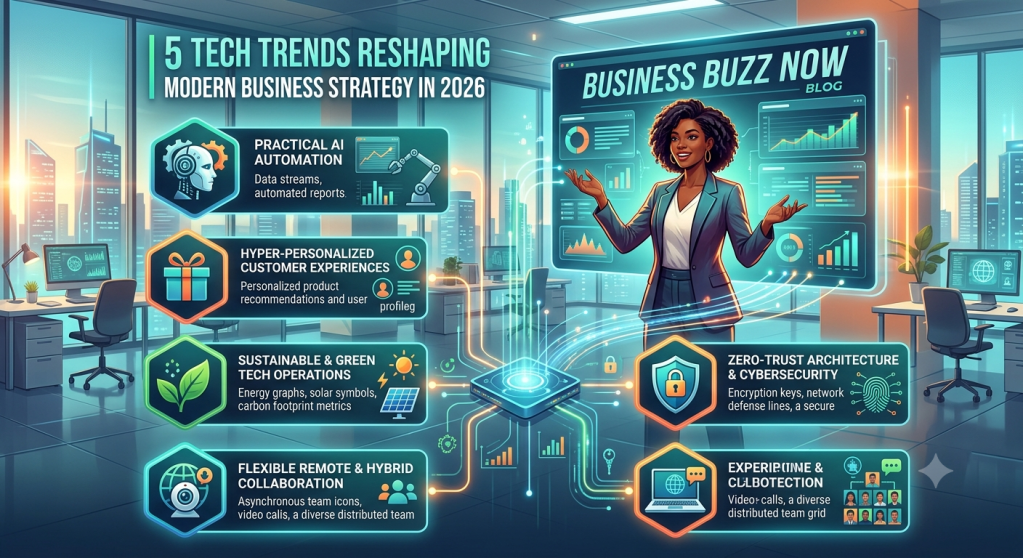
5 Tech Trends Reshaping Modern Business Strategy in 2026
In today’s fast-moving economy, staying ahead of the competition requires more than just keeping up with market shifts—it demands embracing innovation at every level. Modern enterprises that leverage emerging technologies are cutting operational costs, scaling faster, and delivering superior customer experiences.
At Business Buzz Now, we track the high-impact trends transforming the commercial landscape. In this post, we break down 5 major technology trends every entrepreneur, executive, and business leader should integrate into their growth strategy today.
1. Practical AI Automation Across Daily Operations
Artificial Intelligence has evolved from a futuristic concept into an essential business utility. Companies are no longer using AI just for text generation; they are deploying agentic workflows to handle end-to-end tasks:
- Automated Customer Support: AI agents handle complex customer queries 24/7 with human-like accuracy.
- Predictive Inventory Management: Machine learning models predict demand spikes to optimize supply chain inventory.
- Data-Driven Decision Making: Real-time analytics tools turn raw unstructured data into actionable strategic reports.
2. Hyper-Personalized Customer Experiences
Generic, one-size-fits-all marketing campaigns are becoming obsolete. Modern buyers expect personalized interactions tailored to their specific behavior and preferences.
Business Buzz Tip: Leveraging unified CRM platforms allows businesses to deliver targeted product recommendations, custom pricing models, and tailored content, driving higher conversion and customer retention rates.
3. The Rise of Sustainable and Green Tech Operations
Sustainability is no longer just a corporate social responsibility (CSR) bullet point—it is a major factor driving consumer choice and investor decisions.
| Strategic Focus Area | Business Impact | Implementation Strategy |
|---|---|---|
| Paperless Workflows | Reduces administrative overhead | Adopt secure e-signature and cloud document platforms. |
| Energy-Efficient Cloud Hosting | Cuts carbon footprint & server costs | Migrate legacy databases to modern green cloud infrastructure. |
| Sustainable Supply Chains | Enhances brand trust & loyalty | Partner with eco-certified vendors and logistics providers. |
4. Next-Generation Cybersecurity and Zero-Trust Architecture
As businesses expand their digital footprint, cyber threats continue to grow in complexity. Adopting a Zero-Trust Security Framework (“never trust, always verify”) is vital for safeguarding corporate assets.
Verify Identity --> Limit Access Privileges --> Continuous Threat Monitoring
- Multi-Factor Authentication (MFA): Enforce strict authentication across all employee accounts.
- Data Encryption: Secure sensitive client data both at rest and in transit.
- Regular Security Audits: Conduct routine vulnerability assessments to patch potential security gaps before exploitation.
5. Flexible Remote & Hybrid Collaboration Tooling
Distributed teams are now standard across many industries. However, staying efficient across time zones requires the right digital infrastructure.
- Unified Project Hubs: Use centralized project management dashboards to track goals and milestones transparently.
- Asynchronous Communication: Reduce unnecessary meetings by utilizing video updates and structured documentation hubs.
Final Thoughts
Adopting these tech trends isn’t about overhaul for the sake of novelty—it’s about building a resilient, agile enterprise capable of thriving in a digital-first economy.
Which technology trend is currently driving the biggest impact in your organization? Let us know in the comments below, and stay tuned to Business Buzz Now for your daily dose of strategic business insights!


Leave a Reply